
ST. AUGUSTINE MANAGED IT SERVICES
EDR, MDR, and XDR: What They Mean and Which One Your Business Actually Needs
Most IT companies in Northeast Florida sell you a product and move on. At RockIT Solutions, we monitor, manage, and respond — so when something happens at 2 a.m., someone’s already on it. We serve small and medium-sized businesses across St. Johns, Duval, Clay, Putnam, Flagler, and Volusia Counties, and we’ve seen firsthand what happens when businesses outgrow their protection without realizing it.
These three acronyms get used interchangeably online, but they describe very different layers of protection. Understanding the difference could be the deciding factor between stopping a ransomware attack and losing everything.
EDR: Endpoint Detection and Response
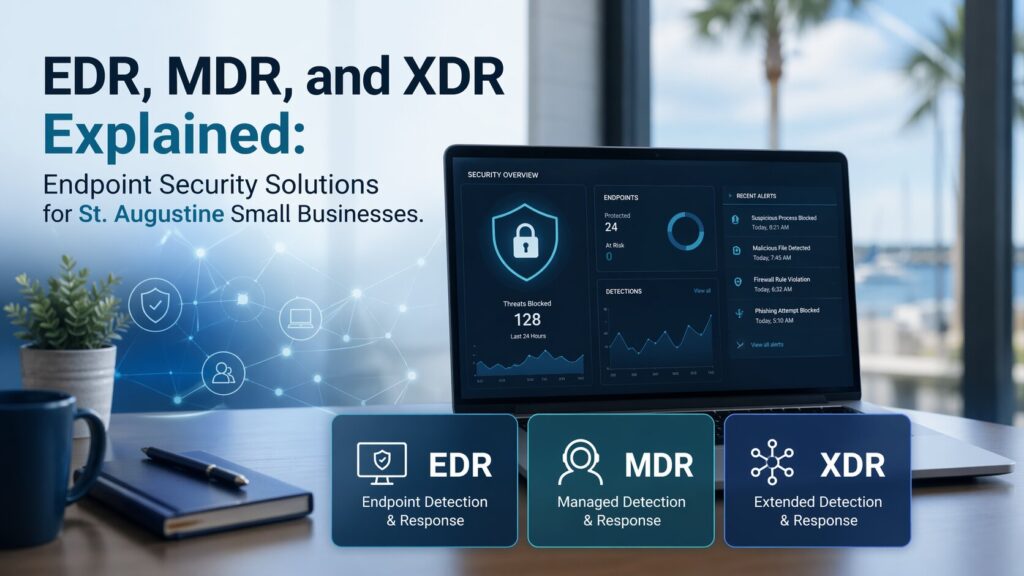
EDR is software installed directly on your endpoints — laptops, desktops, servers, and workstations. It watches for suspicious behavior in real time. Unlike traditional antivirus that only blocks known threats, EDR looks at how software behaves. If a program starts encrypting hundreds of files at once, EDR flags it immediately — even if that malware has never been seen before.
For any business in St. Augustine or across Clay and St. Johns Counties, EDR is the foundational layer. Every device that touches your network needs it. If you’re still running basic antivirus from a few years ago, you’re not protected — you just haven’t had an incident yet.
MDR: Managed Detection and Response
MDR takes EDR further by adding a human element — a team of security analysts who review alerts, investigate incidents, and respond on your behalf. Most small businesses don’t have a dedicated security operations center. MDR gives you one without the overhead of hiring full-time staff.
Think of it this way: EDR is the security camera. MDR is the guard who actually watches it.
The difference matters at 11 p.m. on a Friday when a suspicious login triggers an alert. EDR logs it. MDR acts on it.
XDR: Extended Detection and Response
XDR pulls threat data from endpoints, networks, email, cloud environments, and identity systems — correlating everything into a single view. Where EDR watches one device and MDR adds human response, XDR connects all the dots across your entire IT environment.
For growing businesses with multiple locations, remote workers, or cloud infrastructure, XDR provides visibility that isolated tools simply can’t match. It catches multi-stage attacks that move laterally across your environment — something endpoint-only tools consistently miss.
Which Solution Does Your Business Actually Need?
The honest answer: it depends on your size, your risk exposure, and what you already have in place. Here’s how we typically think about it:
Fewer than 20 endpoints, simple network — EDR with proactive monitoring is usually the right starting point. Get the foundation right before adding layers.
Growing team, remote workers, or sensitive client data — MDR adds the human response layer you need without hiring in-house staff. If employees are accessing company data from home networks in St. Johns or Clay County, you need someone watching.
Multi-location, cloud environments, or compliance requirements — XDR delivers the cross-platform visibility that protects complex operations. If your infrastructure has grown faster than your security strategy, this is where to land.
Healthcare, legal, financial, or government contractors — Compliance frameworks like HIPAA and CMMC often require documented detection and response capabilities. For many businesses in these industries, MDR or XDR isn’t optional — it’s a requirement.
Every RockIT engagement starts with a real assessment of where you are. Two businesses with the same headcount can end up with completely different recommendations based on how their data flows, what they store, and who has access to what.
Signs Your Current Endpoint Protection Isn’t Enough
Most businesses don’t realize they’ve outgrown their security setup until after something goes wrong. These are the warning signs we see most often:
- You’re still relying on basic antivirus software
- Employees use personal devices to access company data
- You’ve had an unexplained slowdown or suspicious email recently
- You store client records, financial data, or protected health information
- Remote workers connect from home networks without a VPN
- You’ve never had a formal security assessment
- Your cyber insurance provider is asking questions you can’t answer
If two or more of those apply, your current setup is almost certainly not keeping up.
Why RockIT Solutions
We’re a veteran-owned managed IT provider based in Northeast Florida. We work with small and medium-sized businesses that need real protection — not a product sale followed by silence.
Proactive, not reactive. Our managed IT services include continuous endpoint monitoring, threat detection, and response. We’re watching before something breaks, not scrambling after.
Local coverage, onsite when it matters. We serve St. Johns, Duval, Clay, Putnam, Flagler, and Volusia Counties with both remote and onsite support. When something needs hands on it, we’re not three states away.
Compliance and risk management. HIPAA, cybersecurity insurance requirements, CMMC — we’ve helped businesses navigate all of it. If you’re not sure what your obligations are, we’ll help you figure that out first.
Virtual CIO for businesses without one. Plenty of our clients don’t have an internal IT lead. We fill that role — not just fixing problems as they come up, but helping you build an IT strategy that makes sense for where your business is going.
Frequently Asked Questions
Is EDR the same as antivirus software? No. Traditional antivirus matches files against a database of known threats. EDR monitors behavior in real time and can detect brand-new threats that have never been seen before. It’s significantly more advanced and is now considered the minimum standard for business endpoint protection.
Does a small business in St. Augustine really need MDR? If you handle client data, process payments, or operate in a regulated industry — yes. Cybercriminals target small businesses specifically because they tend to have weaker protection. MDR gives you a dedicated response capability without the cost of building an internal security team.
How does XDR differ from just having good EDR? EDR only sees what’s happening on individual endpoints. XDR correlates data from your network, cloud services, email platform, and identity systems. It catches multi-stage attacks that move laterally across your environment — something endpoint-only tools consistently miss.
What does endpoint security cost for a small business? It depends on the number of endpoints, the level of monitoring, and what response capabilities you need. We’ve put together solutions for five-person offices and multi-location operations — they looked very different and were priced accordingly. The best starting point is a conversation about your specific setup.
Ready to find out where you actually stand?
We’ll assess your current endpoint security posture and give you a straight answer — not a sales pitch. If what you have is working, we’ll tell you. If it’s not, we’ll show you exactly why and what to do about it.
Call RockIT Solutions today for a free IT security consultation.
